

A 6-year-old yellow Labrador who still launches for tennis balls but rises slowly the next morning captures the central problem for the breed, because rapid growth, heavy adult weight and a predisposition to hip and elbow dysplasia place sustained load on cartilage and the nervous system that reports joint discomfort.
As a neurologist who often pairs careful gait assessment with attention to whole-patient balance, I look less at front-label promises and more at whether per-serving amounts may help support mobility when scaled to a 65- to 80-pound dog, alongside weight control, strength and veterinary diagnosis.
Why Labrador joints wear on a different curve
Labradors mature quickly into muscular, food-motivated adults, and that combination of growth rate, body condition and inherited joint conformation means cartilage must absorb more force with every run, turn and stair climb, while altered proprioceptive feedback may help support a stiffer or more guarded pattern over time.

That background matters because a supplement cannot change conformation or unload excess weight, so I counsel owners to read What Degenerative Joint Disease Actually Is in Dogs and Why Dogs Limp After Resting: Causes and When to See a Vet before expecting any chew to restore a youthful gait.
What per-serving math should show for a Labrador
Glucosamine and chondroitin are among the most studied joint support ingredients for dogs, a status summarized for human osteoarthritis research by NCCIH and widely extrapolated in veterinary formulation, although canine dose-response data remain less precise than owners often assume.
For Labradors, the practical question is whether the label states milligrams per chew or per daily serving for a defined weight band, because a formula that provides a reasonable daily amount for a 25-pound dog in one chew may provide only a fraction of that per-pound intake when the same single chew is offered to a 70-pound Labrador.
When I review Glucosamine HCl Dosage for Dogs: What the Label Should Say and What It Shouldn’t with clients, I ask for three specifics that may help support consistent use, which are the milligrams of glucosamine, chondroitin and total omega-3s per daily serving at Labrador weight, the number of chews that constitute that serving and whether feeding directions adjust clearly from 50 to 90 pounds rather than listing one broad range.
Methylsulfonylmethane, green-lipped mussel and avocado soybean unsaponifiables appear in many formulas, and green-lipped mussel contains omega-3 fatty acids and glycosaminoglycans that have been studied for joint support, while marine oils continue to be investigated in preclinical models.
For example, in a 2026 rat model of adjuvant-induced arthritis, researchers reported that “The results suggested that BMO, GMO, and KO all alleviated paw swelling in rats and reduced serum levels of rheumatoid factor (RF), anti-cyclic citrullinated peptide (anti-CCP) antibody, and pro-inflammatory cytokines such as TNF-α and IL-17” as described by Nutrients in Therapeutic Effect and Underlying Mechanism of Blue Mussel (Mytilus galloprovincialis) Oil on Adjuvant-Induced Rheumatoid Arthritis in Rats, which is observational animal evidence that does not establish a canine dose yet illustrates why source and processing of marine lipids deserve label transparency.
How to compare formulas without chasing bag price
Omega-3s from fish or mussel oil may help support a normal inflammatory response when total eicosapentaenoic and docosahexaenoic acid intake is known, so for a Labrador I prefer products that list milligrams of EPA plus DHA per serving rather than only milligrams of unnamed fish oil, a distinction explored further in Fish Oil Dosage for Dogs by Weight: What the Panel Actually Recommends.
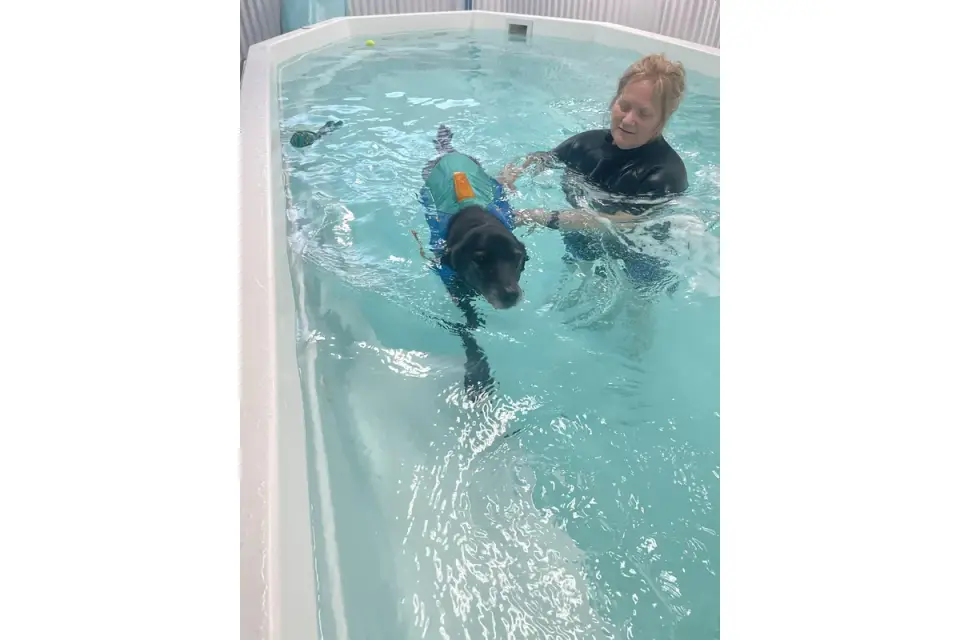
A useful comparison therefore starts with daily cost at Labrador dose rather than cost per bag, then checks for National Animal Supplement Council quality seals, clear lot control, palatability that permits consistent administration and absence of excessive calcium, vitamin D or botanicals that complicate concurrent medications, with Tui-na, controlled leash walks, swimming and acupuncture considered as adjuncts that may help support function alongside conventional care rather than replace diagnosis or weight management.
If lameness is new, unilateral, worsening or accompanied by swelling, fever, loss of appetite or vocalizing, seek veterinary examination promptly rather than trialing a new supplement, and bring the current product label so the clinician can assess total intake across food, treats and topicals within the whole-patient pattern.
Frequently asked questions
What matters most in a joint supplement for a Labrador?
Labeled milligrams per daily serving at 65 to 80 pounds, clear weight-banded directions, EPA plus DHA amounts, quality controls and a plan for weight, exercise and veterinary follow-up.
Should a Labrador take more chews than a small dog?
Often yes, because many labels define a higher daily serving for heavier dogs. Follow the label weight band and your veterinarian's guidance rather than giving a single chew intended for all sizes.
When should limping prompt a vet visit instead of a supplement change?
When limping is sudden, severe, persistent beyond a day or two, affects one leg, or comes with swelling, pain, fever or behavior change.